
Is It Worth It?
On business, marriage, motherhood - and the courage that only arrives after we commit to pursuing them

I haven’t been able to stop thinking about this tweet:
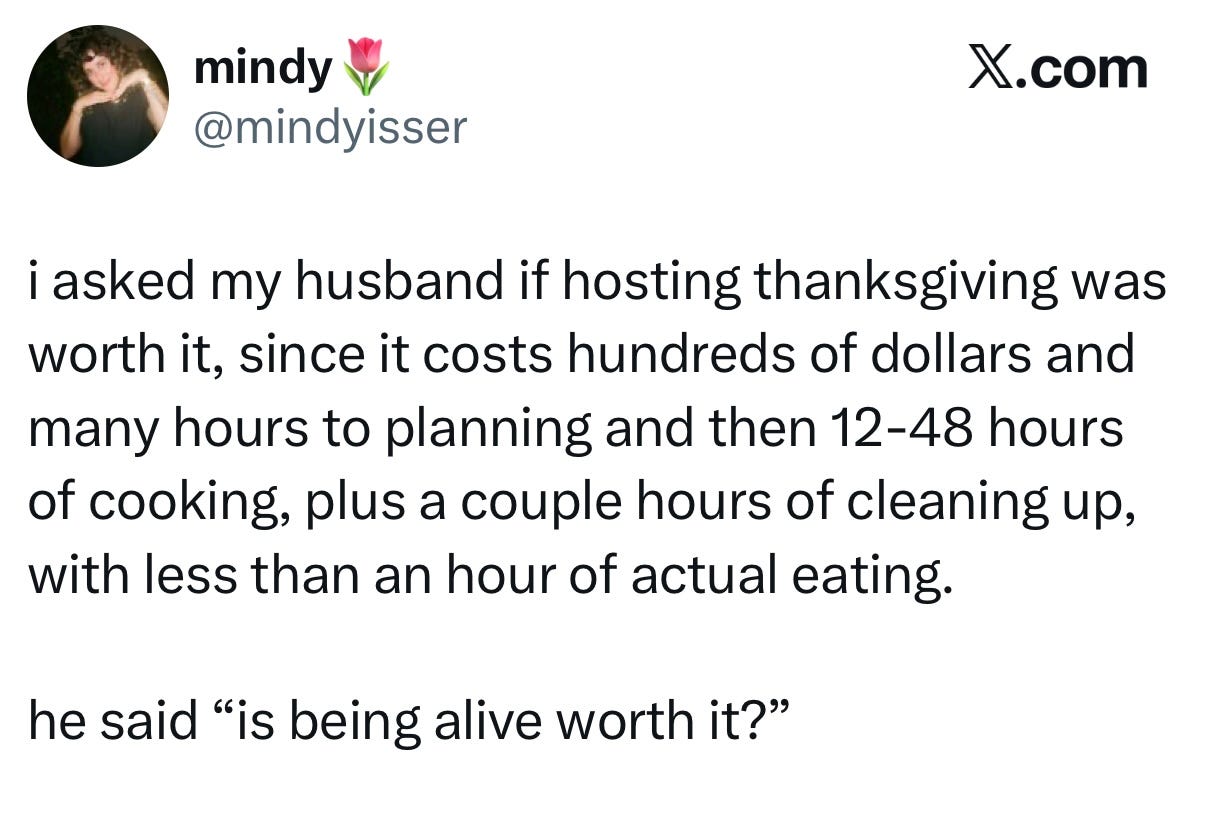
They say if you’re overthinking, write; if you’re underthinking, read. So here I am. The tweet keeps circling back because it captures something I feel everywhere lately: the way we’ve trained ourselves to evaluate life like a transaction. We’ve become so practiced at survival-mode thinking that even when we’re safe enough to want more, our minds still reach for the calculator.
As a female entrepreneur in my thirties, I hear some version of “is it worth it?” all the time around major milestones - the ones generations before us stepped into with a kind of forward motion that didn’t require a thesis defense. Starting a business. Getting married. Having children. All three are now treated like optional upgrades in a life you’re supposed to optimize. As if meaning is only legitimate when it can be proven in advance.
Since I was a kid, I carried those certainties inside: I would build something of my own, I would marry, I would become a mother. They felt like future facts. I neither romanticized nor scrutinized them. I just assumed I would grow into each one. But as I got older, the noise got louder.
When I first considered starting my company, I remember sitting on my apartment floor with my laptop open, searching the most desperate questions: “What percentage of small businesses fail?” “How do you know if you’re cut out for being an entrepreneur?” It’s almost funny now. As if Google could grant me certainty. As if I could crowdsource courage.
What I’ve learned since is that courage isn’t something you find ahead of time. It’s something that shows up after you’ve already started moving. You earn it the way you earn muscle: repetition under strain.
There was a point when I’d burned through my own savings bootstrapping the business, and I still hadn’t raised a dollar of outside capital. Momentum was everything, and I was lucky enough to catch it early. That conviction pushed me to open a new credit card and put all of it on the line - inventory, office rent, my first real push into paid marketing. A fifty-thousand-dollar limit maxed out in two weeks.
I had just started pitching investors and was hearing no after no. Every time I charged something to that card, I felt it in my body - that tight, nauseous lurch of “what if this was the moment I got reckless.” And then right behind it, something steadier: move anyway. Trust anyway. I didn’t have a guarantee. I had a decision to make.
For months, I didn’t know if I’d raise enough to pay that card off. I sold all my jewelry from ex-boyfriends just to cover the minimums. I’d never had the stomach to bet like that before I started the business. But building it trained me into a new kind of self-trust - the kind you earn by surviving your own choices. Starting the company didn’t remove my fear, but it did fire my fear from being the boss.
Marriage came next. I noticed how different the cultural air was from the one my parents breathed. So much of the content I consumed centered around disclaimers: protect your independence, preserve your own finances, keep an exit plan. I understood the warnings, and I still do. But I also knew myself well enough to recognize a pattern I didn’t want to repeat. In the past, whenever a relationship got uncomfortable, I’d slip into some version of “fine, I don’t need this.” I kept one foot out the door, even when I didn’t quite recognize it that way at the time.
I’ll never forget one of the dumbest fights I had with my husband - shortly after we got engaged, but before we were married. We were wedding planning, tired, overscheduled, swimming in details that felt silly and sacred at the same time. He wanted me to compromise. Out of habit, I dug in, ready to win. I wanted the familiar ending: I stand my ground, I prove I’m right, I get my way, I stay safe.
He got quiet and said, sadly, “okay, if that’s what you want.” Something in me softened on the spot. I suddenly saw the cost of needing to be right. The part of myself that loved control more than closeness. I initially felt that old reflex rise back up in me, but as I sat with it, I opened myself up to feeling something newer, harder, better: stay.
Partnership isn’t a place to collect victories, but to practice care. Putting his happiness above mine in that moment didn’t feel like losing myself like I’d feared. It actually felt like becoming someone better. That was the first time I understood love as labor - the invisible, unglamorous kind - and I realized this partnership would demand more of me than any of my old relationships ever allowed.
Marriage asks for endurance. Not in some grand, cinematic way, but in the daily way. In the “can you hold your tongue when you want to punish?” way. In the “can you choose generosity when you’re tired?” way. It asks you to stay in the room when your ego wants to bolt. Marriage has forced me to become more honest, more patient, more aware of both my shortcomings and the places where I’m strong. I didn’t know that kind of growth was waiting there. I couldn’t have measured it beforehand. I only know it now because I chose it.
When it was time for motherhood, I stalled. I don’t love admitting this because people often see me as decisive, maybe even stubbornly brave. But when it came to having a baby, I delayed for years, and it wasn’t because of a change of heart. It was a gradual exposure to all the risks.
Then once I learned I was finally pregnant, I consumed every horror story the algorithm served me. Traumatic birth videos. Postpartum depression confessions. Breastfeeding agony. The sleep deprivation that turns mothers into ghosts. It was like witnessing a warzone through a window.
Previous generations - including our own parents - didn’t have this problem. They experienced childbirth in context - surrounded by family, touch, care, and the hormonal orchestration nature intended. We experience it through TikTok, detached from the magic and overwhelmed by the pain.
When my own labor began, I was terrified, but something happened that no video prepared me for: I rose to meet it. My body understood. My mind steadied. My son arrived, and the world rearranged itself around him. Had I made this decision based on fear alone, I would have missed the single most expansive moment of my existence. It showed me how much we underestimate our capacity until the moment we need it. And then, somehow, we rise.
Some things are better learned in the body, in time, with your own eyes and your own support around you. When you watch other people’s worst moments before you ever live your own, your brain starts flagging life itself as hazardous.
That’s not just about motherhood. It’s happening everywhere.
We live in a world that trains us to aspire to a fast and frictionless life. Everything nudges us to swipe, scroll, upgrade, leave - before anything can ask something real of us. You talk yourself out of something before you’ve given it a chance to get good. Dating apps make love feel like browsing, where discomfort reads as incompatibility and the next option is always one thumb away. Work culture prizes urgency and the sprint, which mocks the slow, stubborn patience required to build something that lasts. Meanwhile childcare is priced like a luxury, costs keep climbing, families are scattered, and loneliness has been normalized into a statistic. So when a decision asks for endurance - through doubt, boredom, repair - our nervous systems call it danger, not devotion. No wonder staying feels impossible.
So yes, it’s fair for people to ask whether starting a business is worth it. Whether marriage is worth it. Whether having a child is worth it. Still, every time I hear the question framed this way, I think about that tweet. About Thanksgiving. About cooking for two days for one hour at the table and how that hour is the whole point.
The most meaningful parts of being human don’t come with an attributable ROI. They come with experiences that rearrange you. They ask you to step forward before you know exactly how you’ll land.
I’m not trying to tell anyone what to choose. These are personal decisions. Timing and circumstances matter. And sometimes the bravest choice is refusing a path that doesn’t fit your life. What I want to offer is a shift in how we evaluate the big decisions, especially in a culture that treats caution like a virtue unto itself. If the only choices we allow ourselves are the ones that feel safe on paper, we end up protecting a life that never really opens.
Yes, fear is loud. So too is the grief of a life postponed.
And maybe that’s the real question beneath “is it worth it”: not whether the outcome is certain, but whether the life you’re guarding is big enough to hold the person you’re becoming.
Love this Rooshy - I find it interesting that a lot of times people ask women 'if it's worth it' and I don't feel like the same is asked of men? I'm actually just now realizing this as I'm reading your piece (which I can relate to a lot). Sending a hug xx
loved this one!